According to the Navigation Rules What Factor Should Be Considered in Determining a Safe Speed
Setting Speed Limits
NEWLY ADDED:
Transportation professionals should also consider special weather condition, such equally intersections, transition zones, work zones and school zones, bicycle and tiresome lanes, safety truck speeds, and possibly the need for variable speed limit systems when designing a road and determining speed limits. The FHWA report Guidelines for the Use of Variable Speed Limit Systems in Moisture Weather condition provides details on how variable speed limits tin can be used during moisture weather conditions for roads where the operating speed exceeds the pattern speed and stopping altitude exceeds the available sight distance. The FHWA Office of Operations provides resources on Work Zone Speed Management from observing to managing speeds in work zones. ITE published a technical brief on Reduced School Area Speed Limits and the Pedestrian and Cycle Information Center provides a school zones resource webpage.
The World Health System Speed Management: A Road Safe Manual for Decision-Makers and Practitioners has sections on Safe Systems and the Role of Speed. Additionally, the Earth Road Association Road Safety Manual, A Transmission For Practitioners And Decision Makers On Implementing Safe System Infrastructure and the Globe Resources Plant report titled Sustainable and Prophylactic: A Vision and Guidance for Zero Road Deaths provides information on how practitioners tin apply the Safe Systems approach to fatalities and offers guidance on safety speed limits appropriate for the type of road, common crash types, safe of all road users, and how to effectively utilise safe data to inform speed direction decisions.
The Insurance Institute for Highway Safety (IIHS) has conducted research on speed limits and provides a resource page on maximum and statutory speed limits in addition to resource provided on the ITE Speed Direction for Rubber resource hub. The IIHS speed webpage provides a table of maximum statutory speed limits on interstates in each state and provides history on maximum speed limits throughout the U.S. as useful background for understanding the nationwide shift of increasing speed limits on interstates.
Design Speed - the selected speed used to determine the various geometric design features of the roadway.
Operating Speed - the speeds at which vehicles are observed operating during free flow conditions. Gratis flow conditions hateful that vehicles are unimpeded by other vehicles or by traffic command devices such every bit traffic signals.
85th Percentile Speed - the speed at or below which 85 percentage of vehicles travel.
Target Speed - the highest operating speed at which vehicles should ideally operate on a roadway in a specific context.
Mean Speed - the summation of the measured speeds of vehicles at a specific location divided past the number of vehicles measured.
Speed Distribution - the arrangement of speed values showing their observed frequency of occurrence.
Posted Speed - the maximum lawful speed for a detail location equally displayed on a regulatory sign.
Speed Limit - the maximum lawful vehicle speed for a specific location.
Statutory Speed - the numerical speed limits established by land law that apply to various classes or categories of roads in the absence of posted speed limits.
Speed Zone - the speed limit established on the basis of an engineering study for particular section of road, for which a statutory speed limit is not advisable.
Advisory Speed - a recommended speed where the need to reduce speed beneath the speed limit is recommended due to a specific road condition.
The FHWA and ITE joint publication on Methods and Practices for Setting Speed Limits: An Informational Report is a comprehensive resource on speed limit basics for transportation professionals and provides the higher up industry definitions. The American Association of Superhighway and Transportation Officials (AASHTO) publication A Policy on Geometric Design of Highways and Streets, seventh edition released in 2018, commonly referred to by the industry every bit the "green volume," has been adopted by the U.S. Section of Transportation every bit the pattern guide for federal roads, and land departments of transportation employ information technology equally the basis for state blueprint manuals.
Blueprint Speed vs. Operating Speed
Transportation professionals involved in speed management utilize two terms when discussing the design and operation of a given road—the design speed and the operating speed. Design speed is used explicitly for determining minimum values for road design, such every bit horizontal curve radius and sight distance. The "green book" outlines means and methods that transportation professionals tin can utilise to select the appropriate design speed based on road type. Ultimately, design speed is selected by an agency with statutory authorisation to ready speeds based on many factors. The selected design speed is then used to determine the diverse geometric design features, most notably the horizontal and vertical curvature. Other geometric design features such every bit cantankerous-section elements, lane widths, shoulder width, the presence of curbs, etc., are adamant based on the road office and safety. Most motorists volition select a speed that they experience is reasonable and safe, influenced by the speed limit and blueprint features of the route. Ideally, the speed a motorist feels is safe is the same as the designs speed selected.
Operating speed is a term used to describe the observed speed of a group of vehicles traveling on a section of road. A group of vehicles typically do not travel at the verbal same speed; thus a speed written report usually creates a speed distribution. With an engineering approach, a speed study is done for a specific road segment during a certain period of time for a specific sample set to make up one's mind mean speed and the speed distribution. From the speed distribution of a speed study, the 85th percentile can be determined from the cumulative distribution plot projecting horizontally from the 85th percentile level to the intersection of the plot and reading the speed at the horizontal axis. The 85th percentile speed may be determined to exist the operating speed, may be because in determining the safest design speed, or as a factor in setting a target speed. Still, at that place are other factors that may need to be considered when determining the safest operating speed. Some transportation professionals are likewise considering other approaches, such as skillful systems, safe system, and possibly a 50th percentile data point for safe urban streets. Ideally, the operating speed should be close to the speed limit.
A speed limit may be higher if vehicles can travel safely at a college speed, or lower if there are other road users, such as bicyclists, that must too need a safe environs to travel. The FHWA Transmission on Compatible Traffic Control Devices (MUTCD) recommends that speed studies exist done when a road design changes, when traffic volumes fluctuate, or when at that place is an identified prophylactic problem. The electric current 2009 MUTCD states that the speed limit should be within five miles per hours (mph) plus or minus of the 85th percentile speed. The MUTCD does recognize that other road characteristics, such equally alignment, parking practices, pedestrian action, etc., are factors in setting safe speed limits. Additionally, a Vision Zero arroyo encourages setting speeds to as well take into consideration other factors such every bit surrounding state use, the history of traffic crashes, injuries and fatalities, and existence of other permissible travel modes such every bit bicycling, walking, or riding transit.
https://safety.fhwa.dot.gov/speedmgt/
ref_mats/fhwasa12004/fhwasa12004.pdf, page 34
Target Speeds and Special Road Conditions
Another term that some transportation professionals are considering relative to speed management and context sensitive design approaches is the concept of target speeds. The concept of target speed is outlined equally the highest speed at which vehicles should operate on a thoroughfare in a specific context, consistent with the level of multimodal activity generated by next land uses, to provide both mobility for motor vehicles and a safe environment for pedestrians, bicyclists, and public transit users. Transportation professionals looking for more information on context sensitive design and speed tin review the ITE recommended do on Designing Walkable Urban Thoroughfares: A Context Sensitive Approach or the ITE Design Factors to Control Speed fact canvass.
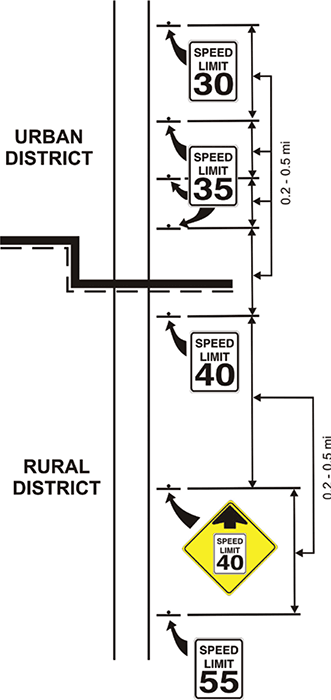
Transportation professionals should too consider special weather condition, such as intersections, transition zones, piece of work zones and schoolhouse zones, bicycle and slow lanes, safety truck speeds, and perchance the need for variable speed limit systems when designing a road and determining speed limits. The FHWA study Guidelines for the Use of Variable Speed Limit Systems in Wet Weather provides details on how variable speed limits can be used during moisture weather conditions to increment stopping distance exceeds the available sight altitude. The FHWA Office of Operations provides resources on Work Zone Speed Direction from observing to managing speeds in piece of work zones. ITE published a technical brief on Reduced School Area Speed Limits and the Pedestrian and Wheel Information Eye provides a school zones resource webpage.
Appropriate Speed Limits
The choice of the speed limit for whatever detail section of a route type is an exercise in weighing the objectives of safety and operational efficiency. The operational efficiency is measured past travel time and the rubber level, measured by the incidence of crashes and resulting injuries and fatalities with consideration of the road function. Freeways and other high-level roads tin can accommodate college speeds because of their pattern features that have petty or no interaction with not-motorized user or adjacent development. Road types with lower functional classes, such as small arterials, collector, and local roads provide for a mix of road users, requiring that safety accept on a higher priority.
Methods for Setting Speed Limits
The FHWA Methods and Practices for Setting Speed Limits: An Advisory Report describes iii approaches for setting speed limits.
Applied science Arroyo - A two-step procedure where a base speed limit is prepare co-ordinate to the 85th percentile speed, the pattern speed for the road, or other conditions. This base speed limit is adjusted according to traffic and infrastructure conditions such as pedestrian use, median presence, etc. Inside the technology approach in that location are two approaches: The Operating Speed Method is set inside five mph of the 85th percentile speed determined from speed surveys and then appropriate changes plus or minus are made based on other considerations. Under the Road Take chances Method, the level of roadside evolution and the function of a road are the primary determinants of the appropriate speed limit.
Skillful Organization Approach - Speed limits are suggested by a computer program that uses noesis and inference procedures that simulate the judgment and behavior of speed limit experts. Typically, this arrangement contains a knowledge base of operations containing accumulated cognition and a set of rules for applying the knowledge to each detail situation. The FHWA adult USLIMITS2 is an expert system. USLIMITS2 is designed to determine speed limits in speed zones on all types of road, from rural two-lane segments to urban freeway segments. Based on input from the user, USLIMITS2 uses a decision algorithm to advise the user of the speed limit for the specific road section. Input into The states LIMITS2 includes: surrounding development; access points; road function; route characteristics (e.grand., divided or undivided, number of lanes, annual boilerplate daily traffic (AADT), roadside hazards, and section length) or freeway characteristics (e.g., number of interchanges, section length, and AADT); existing vehicle operating speeds (50th and 85th percentile); pedestrian action; crash history; and special weather condition (e.g., adverse alignment, transition zones, and parking). There is current industry discussion that an expert system, such every bit USLIMITS2, should be used to validate an technology approach to speed limits.
Safe System Approach - The safe systems arroyo emphasizes that some caste of roadway user fault will always occur, and that such errors should not result in a fatality or serious injury. With this arroyo, speed limits are set co-ordinate to the crash types that are likely to occur, the impact forces that result, and the homo body's tolerance to withstand these forces. In the safe system arroyo, the chief criterion is the safety of all route users, including pedestrians and bicyclists that are more vulnerable to injury and death when hit by a vehicle. Consequently, this approach unremarkably results in lower speed limits than those that would exist determined by the engineering and proficient arrangement approaches. Tactics such as traffic calming, physical separation of roadway users, and treatments that enhance visibility of vulnerable users to give drivers greater reaction time are safe systems. A safety systems arroyo requires a holistic planning of the roads and interconnected factors provide for optimal rubber. The safe systems approach is an platonic approach for many urban roads and to strengthen protection for vulnerable users. The Globe Health Organization Speed Management: A Road Condom Manual for Decision-Makers and Practitioners has sections on Safe Systems and the Function of Speed. Additionally, the World Road Association Road Rubber Manual, A Manual For Practitioners And Decision Makers On Implementing Safe System Infrastructure and the Globe Resource Institute report titled Sustainable and Safe: A Vision and Guidance for Zippo Road Deaths provides information on how practitioners can apply the Safe Systems approach to fatalities and offers guidance on safe speed limits advisable for the type of road, mutual crash types, safety of all road users, and how to effectively use prophylactic data to inform speed management decisions.
The NCHRP report Design Speed, Operating Speed and Posted Speed Practices is also a helpful resources for transportation professionals looking for additional information on the principles of speed. Transportation professionals can learn more on speed limits via the FHWA Speed Limit Basics resource. The FHWA Speed Concepts: An Advisory Guide, published in 2009, is helpful for transportation professionals to determine the well-nigh appropriate speed limits. Additionally, numerous Transportation Research Lath (TRB) studies are currently being conducted to provide guidance on all factors to exist considered in setting speed limits. A 1998 TRB Special Report on Managing Speed can too exist helpful in setting and enforcing speeds. The National Committee on Uniform Traffic Control Devices (NCUTCD) is currently re-examining linguistic communication in the MUTCD related to speed limit setting practices and has conducted a practitioner survey on this topic. The AAA Foundation for Traffic Safety recently released a survey study of practitioners on the Review of Current Practices for Setting Posted Speed Limits in May of 2019. The study investigated the electric current practice of setting a speed limit through a review of the relevant documentation and by a survey of transportation professionals. The research brief also points to the challenges of current practices and future management for speed limit posting.
The Insurance Institute for Highway Safety (IIHS) has conducted research on speed limits and provides a resources page on maximum and statutory speed limits in add-on to resources provided on the ITE Speed Management for Condom resource hub. The IIHS speed webpage provides a table of maximum statutory speed limits on interstates in each state and provides history on maximum speed limits throughout the U.S. every bit useful background for agreement the nationwide shift of increasing speed limits on interstates.
Source: https://www.ite.org/technical-resources/topics/speed-management-for-safety/setting-speed-limits/

Post a Comment for "According to the Navigation Rules What Factor Should Be Considered in Determining a Safe Speed"